Backing board is a useful component in archival storage and presentation supplies. An archival backing board is a piece of acid-free, lignin-free board or card stock used in a bag, sleeve, binder page, or frame to support or “back” a photo, document, print, or other flat item. If this board is also buffered, it helps neutralize acids in the environment. This post will discuss the types of backing boards we offer and how to use them.
Types of Backing Boards Available at Archival Methods
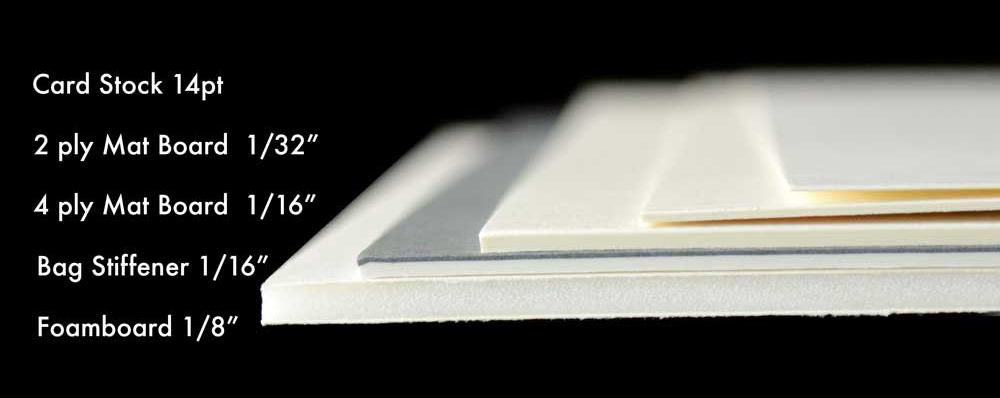
All of the boards listed are acid-free, lignin-free, buffered and pass the PAT. Buffered means calcium carbonate was added during manufacturing so it has acid-neutralizing properties.
- Card Stock
- 2-Ply Conservation or Museum Board
- 4-Ply Conservation or Museum Board
- Archival Bag Stiffeners
- Acid-Free Foamboard
When to Use Backing Board
When storing your family archive and photo collection it’s good to use backing board to support old and fragile materials inside a bag or sleeve. This protects your document in storage and during handling. It also can provide a space to write important information about the photo or artifact.

Backing board is also useful for matting and framing prints and photos. Use polypropylene Mounting Corners to safely attach your piece to the backing board. You want all materials enclosing your collection to be archival quality. The most popular backing boards for matting and framing are 2 ply matboard (conservation or museum board) and acid-free foamboard.
If you are selling matted pieces or showing them in a portfolio, matboard and foamboard are both excellent choices. Foamboard is stiffer and thicker but 2 ply matboard is less expensive. When it comes to framing, some people opt for both.
Card Stock
Card Stock is the thinnest and least expensive option. It is a heavy weight paper or cover paper similar to index cards. When it comes to binder pages, this would be your best choice. These also work well inside sleeves and bags. We have white, gray, and black card stock and they vary in weight. White is the heaviest (14 pt), gray is slightly thinner (12 pt), and black is the thinnest (9 pt). Card Stock is listed in two places on our website.
You will find all the sizes for our Binder Print and Slide Pages under Card Stock Inserts. Inserts are an optional add-on. If the photo is very old, damaged, or dirty it would be good to use card stock behind it when putting photos back-to-back in your pages. Since our card stock is buffered it has acid-neutralizing properties which can be especially helpful for older photos, papers, and newsprint.

Using card stock inserts in binder pages is helpful when you have images that are smaller than the pocket size. These pages are designed to hold photos back-to-back in a pocket. You don’t always need to use a card stock insert in your pocket pages. They do add bulk (black adds the least amount of bulk) so that you won’t fit as many pages in your binder when you use them.
Card stock is also popular as a support inside Enclosures like bags and sleeves. You will also find White Card Stock and Black & Gray Card Stock under our Board and Paper category. If you don’t see the size you need order the next size up and request that we trim it to the size you need (we will cut an entire package down to one size, not multiple sizes).
2 Ply Mat Board
The most economical backing board for matting is 2 ply Pearl Conservation Board. Made from purified wood pulp, it is a less expensive alternative to 100% cotton Museum Board.
Our Pre-Cut Exhibition Mats are a package of five bright white museum board 4 ply window mats with hinged 2 ply backing board. These are great for portfolios and can also be used with Crystal Clear Bags for selling your artwork.

4 Ply Mat Board
When it comes to matting your work for framing, many people opt for a 4 ply window mat hinged to a 2 ply backing board but plenty of people choose 4 ply as their backing. 4 ply is obviously a stiffer support but more expensive. Of all the options listed here, the 4 ply mat boards are the most expensive backing option.
If you opt for a 4 ply window with a 4 ply backer you could go up to about a 16 x 20 size before needing to add additional support (like foamboard) in your frame. At which point I would likely opt for either just a foamboard backing or a 2 ply backing with additional foamboard.
Archival Bag Stiffeners
We began offering Archival Bag Stiffeners again in 2025. We have these in sizes from 8 x 10 up to 16 x 20 and they are made from the gray and white boxboard that we use to make our Metal Edge Boxes. They are a bit more expensive than 2 ply mat board but they are heavier and stiffer. Bag Stiffeners are 1/16″ thick, while 2 ply is 1/32″ thick. The Bag Stiffeners are the same thickness as 4 ply mat board but less expensive.

Acid-Free Foamboard
Our Foamboard is the thickest option at 1/8 inch. It is ideal for structural backing in picture framing and offers long-lasting archival protection. A 4 ply window mat hinged to foamboard will fit into out Crystal Clear Bags. We sell popular sizes as Archival Mat & Presentation Kits. These are great if you are selling your artwork matted and ready to frame at art fairs or in boutiques or museum shops. You can proudly promote that your work is matted with archival supplies for long-lasting preservation.

A Note on Frames and Rabbets
The notched area in a frame where the glazing (glass or acrylic), window mat, artwork, and backing board are seated is called the rabbet. Rabbet depths vary. The metal and wood frames that we carry have enough depth to accommodate these layers but many inexpensive frames from home goods stores have a very shallow depth. If you have a frame, measure the rabbet depth before ordering archival components.

Contact Us
Please contact us if you have questions about archival storage or the products we offer. We’re happy to help!
Resources
Using Acid-Free Backing Boards for Your Collections (Archival Methods Video)
